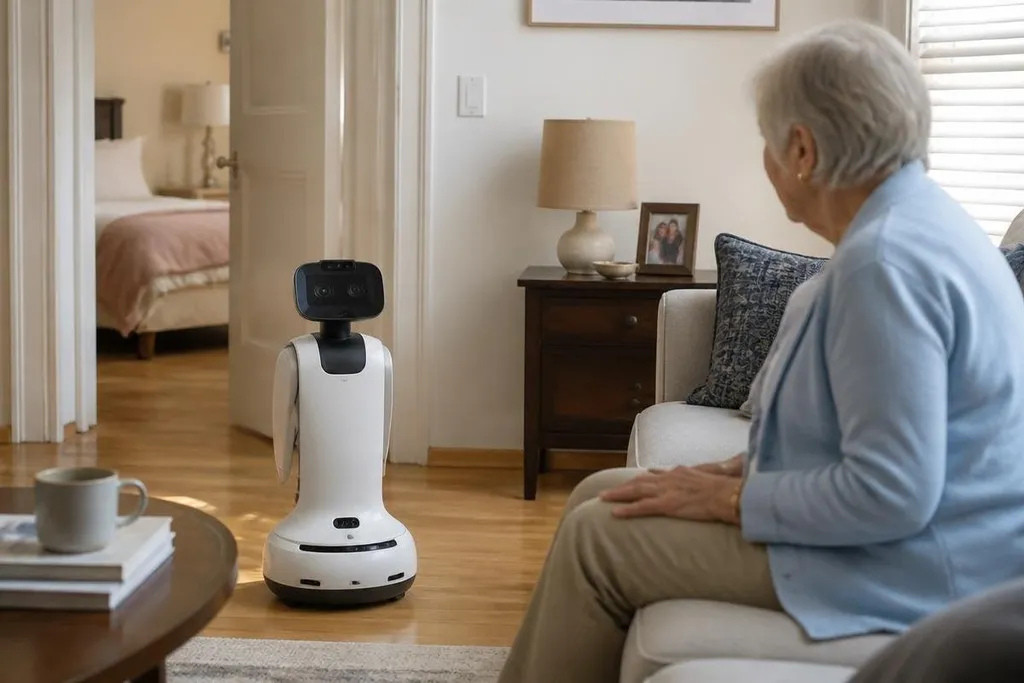
AI can help a care robot understand speech, spot movement, and choose a response. That could support older people with reminders, calls, and basic checks, but the robot still needs a narrow job and a person who can step in.
- Speech tools can sort a spoken request and send it to the right system.
- Vision systems can watch for movement patterns that need attention.
- Human review remains needed for health, safety, and personal care decisions.
What AI adds to a care robot
A basic robot follows set commands. An AI system can work with less exact input. If an older person says, “I need help in here,” speech recognition can turn those words into a request. The robot then needs location data, a safe route, and a clear rule for what happens next.
Computer vision works in a similar way. It reads images from cameras and looks for events such as a person sitting on the floor, leaving a bed, or standing near a doorway. That does not prove a fall or a medical problem. It creates a signal for a care worker or family member to check.
Planning software links these parts. It can rank tasks, check whether a route is clear, and send a message when the robot cannot finish a request. The useful part is the handoff. A care robot should make it easy for a person to see what happened and decide what to do.
Useful jobs in an older person’s home
The safest jobs are easy to describe and easy to check. A robot can remind someone about a scheduled task, start a video call, carry a small item, or alert a contact after a detected event. Each job needs a known limit.
A reminder system, for example, can announce a medicine time. It should not decide that a missed dose is safe, change a dose, or give health advice unless a qualified care service has set that rule. The robot can report the missed reminder and wait for a person to respond.
The same rule applies to social contact. A robot can start a call with a chosen contact, read a message aloud, or help someone reach a family member. It should not present itself as a friend or hide the fact that a person is not on the other end.
A care robot’s task, test setting, and human role matter as much as its AI label. Elder care robotics reports from Robot24.com can place those details beside claims about reminders or family calls, before the next section checks where the system can fail.
Where the system can fail
An AI model may misunderstand a quiet voice, an unfamiliar accent, or a request made during stress. A camera may lose sight of someone behind furniture. A mobile robot may stop when a pet, loose cable, or visitor blocks its route.
These errors matter more in a home than in a controlled demo. A false alarm can disturb a person at night, while a missed event can delay a call for help. The design needs a clear alarm path, a record of what the system saw, and a way to cancel or correct an alert.
Privacy needs the same care. Cameras and microphones can collect details about health, routines, visitors, and rooms. Before buying or installing a system, ask where data is stored, who can view it, how long it stays there, and what happens if the internet connection fails.
My view is that elder care robots should start with reminders, communication, and alert routing rather than hands-on medical work. Those jobs still need care, but a person can check the result without asking a robot to make a health decision.
A practical buying checklist
Use these questions before a trial or purchase:
- Name the job: Write down the exact task the robot must complete.
- Set the handoff: Identify who receives an alert and how fast they can respond.
- Check failure behavior: Ask what the robot does after a blocked route, lost connection, or missed command.
- Review data access: Confirm camera, microphone, storage, and deletion settings.
- Test the home: Check doors, floor surfaces, lighting, stairs, pets, and charging space.
- Measure the result: Record missed alerts, false alarms, completed tasks, and help calls.
A trial should compare the robot with the current care routine, not with a polished product video.
If the robot saves time without making the older person feel watched or ignored, the job may be worth keeping. If it adds alerts that nobody answers, the system needs a smaller task or a different design.
The next useful proof will come from named care sites that report completed tasks, missed events, response times, and privacy controls. Until those details are available for a specific robot, treat broad AI claims as a starting point, not a care plan.